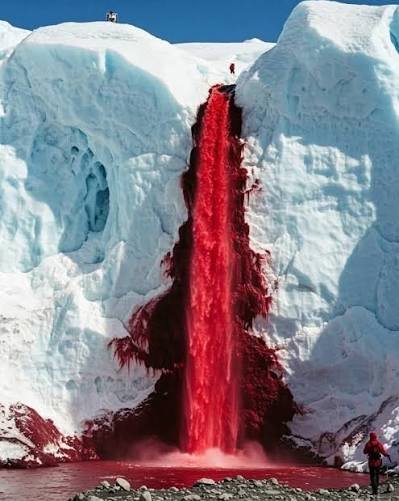
Blood Falls Antarctica: Why the Waterfall Runs Red
A glacier in East Antarctica leaks rust-red brine onto the ice. It looked like blood to the explorers who found it in 1911. Here's what's actually going on, what lives inside it, and whether you can see it yourself.
By Amer Khan | 9 min read
Is there really a waterfall in Antarctica that bleeds? Sort of. Blood Falls is a stream of salty, iron-rich water that seeps out of the end of Taylor Glacier and stains the ice a deep rust red. It isn't blood, and it isn't algae, which is what the first people to see it assumed.
The real story is stranger. The water comes from an ancient pocket of seawater sealed under the glacier for millions of years. It stays liquid well below freezing. And it's full of microbes that live without sunlight or oxygen.
Scientists have spent more than a century figuring it out, and a new study in 2026 added another piece. Here's what we know.
The Basics
1. What and Where Is Blood Falls?
A red stain on a white glacier, far from the usual cruise routes
Blood Falls sits at the snout of Taylor Glacier, where it meets the frozen surface of Lake Bonney in Taylor Valley. That's in the McMurdo Dry Valleys, one of the driest places on Earth, across McMurdo Sound from the US McMurdo Station and New Zealand's Scott Base.
It isn't a waterfall in the Niagara sense. Brine seeps and trickles down the glacier face in pulses, leaving a frozen red fan that's often described as about five stories tall. Some years it flows more than others, and scientists still don't fully understand what triggers each pulse.
Detail
Blood Falls
Location
Taylor Glacier, Taylor Valley, McMurdo Dry Valleys, Victoria Land
Coordinates
About 77.72° S, 162.27° E
Flows into
West Lake Bonney
Distance to sea
More than 20 miles (32 km) inland
Nearest bases
McMurdo Station (US) and Scott Base (NZ)
Protection
Antarctic Specially Protected Area No. 172 (permit required)
It's also visible from space. Zoom into Taylor Glacier on Google Earth and the red streak stands out clearly against the white ice.
History
2. Who Found It
A geologist on Scott's last expedition, and a wrong guess that stuck for decades
Blood Falls was first documented in 1911 by Australian geologist Thomas Griffith Taylor during Robert Falcon Scott's Terra Nova Expedition. Taylor Glacier and Taylor Valley carry his name.
Taylor and his colleagues guessed the red color came from red algae. It was a reasonable guess for the time, since algae do tint snow red in parts of the polar world. It was also wrong, and the algae theory hung around for decades before chemistry caught up with it.
Taylor was one of several scientists on that expedition whose work still shapes Antarctic research. Our guide to famous Antarctic explorers covers the rest of the Terra Nova story.
The Color
3. Why the Water Is Red
It's rust, but not the ordinary kind
The brine under Taylor Glacier is loaded with dissolved iron. Underground, there's no oxygen, so the water looks clear. When it reaches the surface and meets air, the iron oxidizes and the water turns orange-red. It's the same basic chemistry as a rusting nail, happening in real time on a glacier.
A 2023 study from Johns Hopkins University, published in Frontiers in Astronomy and Space Sciences, added a twist. Using electron microscopes, researcher Ken Livi and his team found that much of the iron isn't in mineral crystals at all. It's packed into tiny iron-rich nanospheres, about one-hundredth the size of a human red blood cell, that turn red as they oxidize.
That's why earlier studies struggled to find the source. Standard mineral tests look for crystals, and these particles don't have a crystal structure.
The Physics
4. Why It Doesn't Freeze
Salt, plus a neat trick of physics
Taylor Glacier is frozen to its bed, and the air in the Dry Valleys is far below freezing for most of the year. Liquid water shouldn't be moving through it. Yet it does.
In 2017, a team led by Jessica Badgeley and glaciologist Erin Pettit of the University of Alaska Fairbanks used radar to map the plumbing under the glacier. Their results, published in the Journal of Glaciology, showed two things:
Salt lowers the freezing point. The brine is so salty that it stays liquid at temperatures around -5°C (23°F), well below the freezing point of fresh water.
Freezing releases heat. When some of the water freezes, it gives off heat that warms the ice around it. That keeps the rest of the brine flowing.
The radar traced the brine along a path of roughly 300 feet (90 m) from a reservoir under the glacier to the falls. The finding made Taylor Glacier the coldest known glacier with persistently flowing water.
Seawater that's been sealed in for millions of years
The brine is a leftover ocean. When Antarctica was warmer, seawater flooded parts of the Dry Valleys. As Taylor Glacier advanced, it sealed a pocket of that water underneath. Over time, freezing concentrated the salts, leaving a brine far saltier than today's ocean. As it sat against the bedrock, the water also dissolved iron from the rock below.
Estimates of its age have shifted as the science improved:
2009: Microbiologist Jill Mikucki's team, publishing in Science, estimated the microbial community had been isolated for about 1.5 million years.
August 2026: A study in Nature Geoscience, led by Andrew Allen of the Scripps Institution of Oceanography, analyzed 167 samples of sediment, water and air. It traced the brine's marine origins to roughly 2.5 million years ago.
The reservoir itself lies about 1,300 feet (400 m) beneath the glacier surface. No one has sampled it directly. Everything we know comes from what leaks out at the falls and from radar.
Extreme Life
6. Life Without Light or Oxygen
Microbes that breathe iron instead of air
Here's the part that surprised scientists most. The brine isn't sterile. It's home to a community of microbes that have lived in total darkness, with no oxygen and no fresh food supply, for a very long time.
Mikucki's 2009 study showed how they do it. Instead of using oxygen, the microbes use sulfate and iron in the brine to process small amounts of organic carbon. The iron acts as a kind of recycling partner, so the same sulfate gets used over and over. It's a slow, steady way to stay alive for hundreds of thousands of generations.
The 2026 Nature Geoscience study went further. It found that more than 60% of the diatoms in the red sediment had marine ancestry, along with other ocean-linked organisms such as dinoflagellates and ciliates. In other words, the life at Blood Falls looks like descendants of an ancient sea that got trapped with the water.
Antarctica's better-known wildlife is easier to spot. Our Antarctic krill guide covers the tiny animal that feeds almost everything else on the continent.
Space Science
7. Why NASA Cares
A test case for finding life on Mars and icy moons
Cold, salty water under ice, with life that doesn't need sunlight. That describes Blood Falls, and it's also what scientists think could exist on Mars or under the ice shells of Jupiter's moon Europa and Saturn's moon Enceladus.
The 2023 Johns Hopkins team treated Blood Falls like a rover mission. They asked a simple question: would the instruments on today's Mars rovers identify what makes the water red? The answer was no. Rover tools would miss the tiny, non-crystalline nanospheres entirely. Spotting them took a transmission electron microscope, which is far too large to send to Mars.
That's a useful warning for planetary scientists. If Blood Falls fooled us on Earth for a century, a similar feature on another world could fool a rover too.
Possible, but rare, expensive and never guaranteed
Most Antarctica trips never come close. More than 90% of cruises go to the Antarctic Peninsula, which is on the opposite side of the continent. Blood Falls is in the Ross Sea region, south of New Zealand.
Even there, you can't simply walk up to it. The lower Taylor Glacier and Blood Falls are an Antarctic Specially Protected Area (ASPA No. 172), which means entry requires a government permit, usually granted only for research. The rest of the Dry Valleys is a managed area with set visitor zones.
For travelers, the realistic route looks like this:
Join a Ross Sea voyage that carries helicopters. These trips usually sail from New Zealand or Australia and run about four weeks.
Hope for flying weather in McMurdo Sound. When conditions allow, some voyages fly guests over or into the Dry Valleys visitor zones, where you may see Taylor Glacier from a distance or from the air.
Budget for it. Ross Sea voyages generally start well above Peninsula prices, often $25,000 or more per person.
Question
Answer
Which region?
Ross Sea / McMurdo Sound, not the Peninsula
Departure ports
Usually New Zealand or Hobart, Australia
Trip length
About 4 weeks
Can you land at the falls?
No, it's a protected area; views are from the air or a distance
No. The red color comes from iron in salty water that rusts when it meets the air. Early explorers guessed it was red algae, which also turned out to be wrong.
Where exactly is Blood Falls?
At the end of Taylor Glacier in Taylor Valley, part of the McMurdo Dry Valleys in East Antarctica. It's across McMurdo Sound from McMurdo Station and Scott Base, and more than 20 miles from the open sea.
Does Blood Falls flow all year?
No. It flows in pulses, and some years show more red than others. Scientists are still working out what triggers each release.
Can I see Blood Falls on a normal Antarctica cruise?
No. Standard cruises go to the Antarctic Peninsula, thousands of miles away. You'd need a Ross Sea voyage with helicopters, and even then a view is never guaranteed.
Is the water at Blood Falls dangerous?
Not in any dramatic way, but no visitor gets close enough to find out. The site is a protected area, and access is limited to permitted researchers.