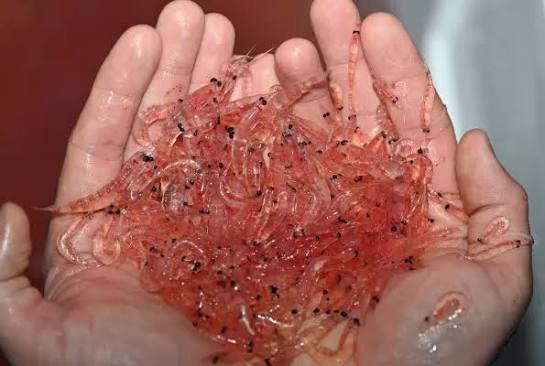
You'll probably never get a good look at a krill in Antarctica. You'll see what it does, though, everywhere. The humpback surfacing beside your Zodiac is feeding on it. The pink stains streaking a penguin colony are digested krill. The crabeater seals lined up on an ice floe eat almost nothing else. Take krill out of the Southern Ocean and most of the wildlife that draws people south disappears with it.
Antarctic krill (Euphausia superba) is a small, shrimp-like crustacean that lives in huge swarms around the continent. It is one of the most abundant animals on Earth by total weight. It also shapes the climate, supports a growing commercial fishery, and is at the center of one of Antarctica's biggest conservation debates. Here's what's worth knowing before you go.
Quick Answer
Antarctic krill are shrimp-like crustaceans about 6 cm (2.4 in) long that live in dense swarms in the Southern Ocean. They eat phytoplankton and ice algae and are the main food for whales, seals, penguins, seabirds, fish, and squid. Scientists estimate there are around 400 million tonnes of them. You won't usually see krill up close on a cruise, but you'll see the signs: feeding whales, pink penguin guano, and occasionally red-tinted swarms near the surface.
Species Profile
1. What Is Antarctic Krill?
One of about 85 krill species, and the one that matters most here
Krill is a general name for a group of roughly 85 small crustaceans found in oceans worldwide. The word comes from Norwegian and loosely means "small fry of fish." Five krill species live in the Southern Ocean. When people talk about "krill" in an Antarctic context, they almost always mean one: Antarctic krill.
It lives south of the Antarctic Convergence, the boundary where cold polar water meets warmer water to the north. Much of the population is concentrated in the Atlantic sector, particularly the Scotia Sea and the waters around the Antarctic Peninsula and South Georgia. That's also where most tourist voyages go, which is no coincidence. Where krill gather, wildlife follows.
- Scientific name: Euphausia superba. The "superba" is earned: it's the largest of the Southern Ocean krill.
- Relatives: Krill are crustaceans, related to shrimp, crabs, and lobsters, though they aren't true shrimp.
- Color: Mostly transparent with reddish-orange pigment spots, which is why large swarms can tint the water pink or red.
Biology
2. Size, Lifespan & a Few Odd Tricks
Small, long-lived, and able to shrink on purpose
An adult Antarctic krill is roughly the length of a little finger and weighs a little over a gram. That's large for a krill. It's also long-lived for such a small animal, with estimates generally ranging from five to ten years.
| Adult length | About 6 cm (2.4 in) |
| Adult weight | A little over 1 gram |
| Lifespan | Usually estimated at 5–10 years |
| Eggs per brood | Up to about 8,000, with several broods per season |
| Estimated total biomass | Around 400 million tonnes |
Krill have a few habits that surprise most people:
- They glow: Krill carry light-producing organs and are bioluminescent, though you'd need to be in dark water at night to notice.
- They can shrink: Krill molt throughout their lives. When food runs short, they can molt into a smaller body rather than a larger one, which lowers their energy needs.
- They can go hungry for a long time: Lab studies suggest krill can survive more than 200 days without food.
- They escape by molting: A krill can shed its shell suddenly and dart away, leaving a predator with an empty decoy.
Diet
3. What Krill Eat
Phytoplankton in summer, ice algae in winter
Krill are mainly grazers. Their front legs form a fine-meshed feeding basket that filters phytoplankton, the microscopic plant-like algae that bloom across the Southern Ocean during the long summer days.
- Summer: Phytoplankton blooms, especially diatoms, make up most of the diet.
- Winter: Krill scrape algae from the underside of sea ice, which works a bit like a nursery and pantry for young krill.
- Lean times: They'll also eat small animal plankton and detritus from the seafloor.
That link to sea ice matters. Years with less winter ice generally mean fewer young krill survive, which ripples up through everything that eats them.
Behavior
4. Swarms and Daily Migration
Tens of thousands in a single cubic metre
Krill live in swarms, and those swarms can be staggering. Densities of up to about 30,000 individuals per cubic metre of water have been recorded. Some swarms stretch for kilometres. A whale doesn't hunt krill one at a time. It finds a swarm and engulfs it.
Many krill also make a daily vertical trip. They generally sink to deeper, darker water during the day, where they're harder for visual predators to see, and rise toward the surface at night to feed. The pattern varies with season and location, and in the near-constant daylight of the Antarctic summer it can break down.
This is part of why krill are so hard to see from a ship. On most days, the swarms are below you. You'll see them on an echo sounder long before you'll see them with your eyes.
Whale sightings follow the krill. Some itineraries spend far more time in the feeding grounds around the Peninsula and South Georgia than others. We can help you choose one that does.
Plan My Antarctica Trip
Food Web
5. The Animals That Depend on Krill
Almost everything you came to see
The Antarctic food web is unusually short. In many oceans, several layers of small fish sit between plankton and the big predators. In the Southern Ocean, krill often fills that whole middle layer on its own. That's why it's called a keystone species.
- Baleen whales: Humpback, minke, fin, and blue whales migrate south to feed on krill in summer. NOAA notes the largest blue whales may eat up to 6 tons of krill a day.
- Crabeater seals: Despite the name, they eat almost nothing but krill, straining it through specially shaped teeth.
- Penguins: Adélie, chinstrap, gentoo, and macaroni penguins all rely heavily on krill, especially while feeding chicks.
- Leopard seals: Close to half of a leopard seal's diet is often krill. Our leopard seal guide covers how they sieve it through their teeth.
- Seabirds, fish, and squid: Albatrosses, petrels, Antarctic fish, and squid all eat krill, and many of them are eaten in turn by larger predators.
As whale populations recover from commercial whaling, their demand for krill is rising again. Scientists now study how whale recovery, a warming ocean, and a growing fishery all compete for the same food.
Climate
6. Krill and the Climate
A small animal with a large carbon footprint, in a good way
Krill help move carbon from the surface of the ocean into the deep. They eat carbon-rich phytoplankton near the surface, then release dense fecal pellets that sink quickly. They also shed their shells as they molt, and those sink too.
A 2024 study in Nature Communications, led by researchers at Imperial College London, estimated that Antarctic krill help store at least 20 million tonnes of carbon in the deep ocean each year. That's comparable to the carbon stored by coastal habitats like mangroves, salt marshes, and seagrass meadows.
Krill are also sensitive to warming. A 2019 study led by the British Antarctic Survey found that the center of the krill population in the southwest Atlantic had shifted south by roughly 440 km (about 4° of latitude) over four decades, as conditions at the northern edge of their range became harder for young krill to survive.
Conservation
7. The Krill Fishery
Managed carefully, and closely watched
Krill is fished commercially, mostly for krill oil supplements and for feed used in fish farming. The fishery is managed by CCAMLR, the international commission responsible for conserving Antarctic marine life. Fishing is concentrated in the same waters around the Antarctic Peninsula and South Georgia where many penguins and whales feed.
- The catch trigger: CCAMLR sets a precautionary limit of 620,000 tonnes for the main fishing area. Once catches reach it, the fishery closes for the season.
- Recent seasons: The fishery hit that limit and closed early two years in a row, on August 1, 2025, and on August 12, 2026.
- The debate: Industry groups point to the closures as proof the precautionary system works. Conservation groups worry that catches are increasingly concentrated in small areas near penguin colonies and whale feeding grounds.
- What's next: Proposals for a Marine Protected Area around the Antarctic Peninsula and finer-scale fishery management are on CCAMLR's agenda.
For perspective, the catch is still a small fraction of the estimated total krill population. The concern is less about total numbers and more about where and when the fishing happens.
Field Tips
8. Where and How to See Krill on Your Trip
Look for the signs, not the animal
Krill mostly stay out of sight. But once you know what to look for, you'll notice their influence almost every day of the voyage.
- Pink guano: Penguin colonies stained pink or reddish-brown are a sure sign the birds are eating krill. It's also, fair warning, what you'll be smelling at most landings.
- Feeding whales: Humpbacks lunging at the surface or blowing bubble nets are almost always feeding on krill swarms just below. Your Zodiac driver will often cut the engine and let you watch.
- Red patches in the water: On calm days, dense swarms sometimes show near the surface as reddish or pinkish patches.
- Krill on the beach: After storms, you may find stranded krill along the tideline at landing sites.
- Onboard science: Many expedition ships run plankton tows or citizen-science programs. If yours does, it's the easiest way to see a live krill up close.
The best areas for krill-driven wildlife are the Antarctic Peninsula's channels and bays, especially later in the season (February to March), when humpback feeding activity is often at its peak.
Who Eats Krill? At a Glance
The main krill predators you're likely to see on an Antarctic Peninsula voyage, and what to watch for.
| Animal | How It Eats Krill | What to Watch For |
|---|
| Humpback whale | Lunge feeding and bubble nets | Tail flukes, lunging jaws, rings of bubbles at the surface |
| Blue & fin whales | Engulfs whole swarms in one gulp | Tall blows in open water; less common on Peninsula trips |
| Crabeater seal | Strains krill through lobed teeth | Groups of pale seals resting on ice floes |
| Adélie, chinstrap & gentoo penguins | Catch krill on short foraging dives | Pink-stained colonies and porpoising groups at sea |
| Leopard seal | Sieves krill; also hunts penguins | A lone seal on a floe near a penguin colony |
| Seabirds | Pick krill from the surface | Petrels and albatrosses gathered over feeding whales |
Frequently Asked Questions
How big are Antarctic krill?
Adults generally reach about 6 cm (2.4 in) and weigh a little over a gram. That's large for krill but small enough that a single whale can swallow hundreds of thousands in one mouthful.
Why is krill so important to Antarctica?
Krill is the main link between tiny phytoplankton and larger animals. Whales, seals, penguins, seabirds, fish, and squid all depend on it directly or indirectly, so changes in krill numbers affect almost the whole ecosystem.
Can you see krill on an Antarctica cruise?
Sometimes, but usually indirectly. You're far more likely to see feeding whales, pink penguin guano, or reddish swarms near the surface than a single krill. Ships with plankton tows or citizen-science programs give you the best chance at a close look.
Is krill fishing a threat to Antarctic wildlife?
It's debated. The total catch is small compared to the estimated population, and CCAMLR closes the fishery when it reaches its precautionary limit. Critics argue that fishing is concentrated in areas where penguins and whales feed, so local impacts could matter more than the overall numbers suggest.
Why is penguin poop pink?
Krill contain a reddish pigment called astaxanthin. Penguins that eat a lot of krill produce pink or reddish guano, which is why many colonies look stained from a distance.
A Note on Krill Science
Krill are hard to count. They're small, patchy, and spread across a huge ocean, so figures like total biomass and lifespan are estimates that researchers continue to refine. Treat the numbers here as the current best picture, not fixed facts.
Browse All Wildlife
Meet the Animals Krill Keeps Alive
Krill is where the Antarctic food web starts. Explore the whales, penguins, and seals that depend on it, from humpbacks and minke whales to Adélie penguins, crabeater seals, and leopard seals.
Browse All Wildlife
Want to see Antarctica's wildlife at its busiest? We'll help you choose the ship, season, and itinerary that spend the most time where the krill, and the whales, are.
Get in Touch