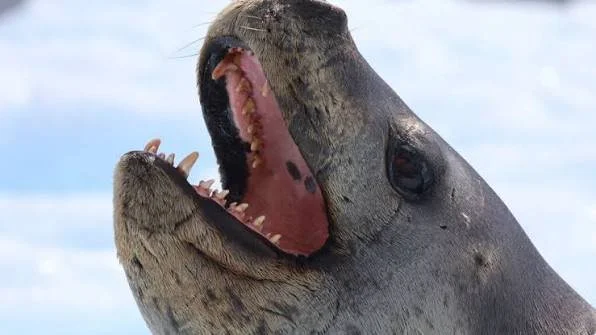
Most people come to Antarctica for the penguins. The animal that tends to stop a Zodiac full of travelers mid-sentence is the one eating them. A leopard seal lying on an ice floe looks almost lazy: a long, spotted body, a head too big for a seal, and a mouth that seems to curve into a grin. Then it slides into the water without a splash, and every penguin on the nearby shoreline suddenly gets very careful about when it jumps in.
The leopard seal is the top predator of the Antarctic pack ice, second only to the orca in the Southern Ocean food chain. It's also one of the most misunderstood animals on the continent. Yes, it hunts penguins. It also strains krill through its teeth like a whale, sings underwater for hours, and spends most of its life alone. Here's what's worth knowing before you go looking for one.
Quick Answer
The leopard seal (Hydrurga leptonyx) is Antarctica's top seal predator. Females grow up to about 3.8 m (12.5 ft) and 500 kg (1,100 lb), larger than males. They eat krill, fish, squid, penguins, and young seals, and are the only seal that regularly hunts other warm-blooded animals. On Antarctic Peninsula voyages, you'll most often see them from a Zodiac, resting on ice floes near penguin colonies between December and March.
Species Profile
1. What Is a Leopard Seal?
A true seal built like a predator
The leopard seal is a "true" or earless seal, in the same family as the Weddell, crabeater, and Ross seals that share its range. It is the only member of its genus. The name comes from the dark spots on its silver-grey throat and chest, not from any relation to the big cat, though the comparison fits its lifestyle well enough.
It lives all the way around Antarctica, generally following the edge of the pack ice as it grows in winter and shrinks back in summer. Some individuals range much farther north than other Antarctic seals, turning up on sub-Antarctic islands like South Georgia and even along the coasts of New Zealand, Australia, South America, and South Africa. New Zealand now records enough visitors that researchers there keep a photo catalogue of individual seals identified by their spot patterns.
- Scientific name: Hydrurga leptonyx, roughly "slender-clawed water worker."
- Social life: Solitary. Adults come together mainly to mate, and mothers stay with pups for about four weeks.
- Natural predators: Only the orca, and even that is rarely recorded.
- Lifespan: Usually estimated at around 26 years in the wild, with records up to about 30.
Anatomy
2. Size, Build & That Reptilian Head
Bigger females, and a jaw that opens remarkably wide
Leopard seals are the second-largest seal in Antarctica after the southern elephant seal. Unusually for seals, the females are bigger than the males. A large female can outweigh an adult male by 150 kg or more.
The body is long and streamlined, with oversized front flippers that drive fast turns underwater. The head is the giveaway. It's broad, flat, and almost snake-like from above, with a jaw that can open far wider than you'd expect. Inside are long, curved canines at the front and, farther back, oddly shaped three-pointed cheek teeth that interlock when the mouth closes.
| Adult female length | About 2.9–3.8 m (9.5–12.5 ft) |
| Adult female weight | About 260–500 kg (575–1,100 lb) |
| Adult male length | About 2.8–3.3 m (9–11 ft) |
| Adult male weight | Up to roughly 300 kg (660 lb) |
| Pup at birth | About 1.5 m (5 ft) and 30 kg (66 lb) |
Those cheek teeth matter more than the canines. They work as a sieve, letting a leopard seal gulp a mouthful of seawater and push it back out while trapping krill inside. The same animal that can take down a penguin can also feed like a filter-feeding whale.
Diet
3. What Leopard Seals Eat
Mostly krill, which surprises almost everyone
The penguin-hunting reputation is earned, but it's only part of the menu. Across much of their range, krill and other small crustaceans generally make up close to half of what leopard seals eat. The rest shifts with location and season.
- Antarctic krill: The staple for many seals, especially younger animals still learning to hunt larger prey.
- Penguins: Gentoo, Adélie, and chinstrap penguins are the usual targets, with fledglings especially vulnerable when they first enter the water in late summer.
- Fish and squid: Taken opportunistically throughout the year.
- Other seals: Mainly young crabeater seals and fur seal pups. Many adult crabeater seals carry long parallel scars from leopard seal attacks they survived when young.
- Carrion: Whale carcasses are fair game when available.
That range is why the leopard seal is usually described as the Antarctic's apex seal. No other seal here regularly hunts warm-blooded animals.
Behavior
4. How They Hunt Penguins
Patience at the ice edge, then speed
Leopard seals are ambush hunters. A common tactic is to wait just below the surface near a colony's landing spot, where penguins have to enter and leave the water. Penguins know this, which is why you'll often see a group bunch up on the shoreline, hesitating, until one jumps and the rest follow.
Once a seal catches a penguin, it often thrashes it hard against the water surface, sometimes over and over, to strip the skin and feathers before eating. It's loud, it's messy, and if it happens near your Zodiac, the expedition staff will usually hold position so everyone can watch. Most travelers find it more fascinating than grim. It's also a useful reminder that the penguin colonies you visit aren't a petting zoo.
The burst speed is what makes the ambush work. Leopard seals can reach about 40 km/h (25 mph) in short sprints, which is fast enough to close on a porpoising penguin in open water.
Some itineraries spend far more time around penguin colonies and pack ice than others, and that's where leopard seals hunt. We can match you with a voyage that gives you the best odds.
Plan My Antarctica Trip
Science
5. The Seal That Sings
Hours of structured song under the ice
During the Antarctic spring and summer breeding season, male leopard seals hang head-down in the water and sing. The calls are low trills, moans, and haunting descending tones, and they carry a long way underwater. Individual males have been recorded singing for as long as 13 hours.
A 2025 study led by researchers at the University of New South Wales analyzed recordings of 26 males in East Antarctica. It found that each male uses a small set of call types arranged into repeatable songs, with a level of predictability the team compared to human nursery rhymes. The likely message is simple: I'm big, I'm healthy, and I can keep this up all day.
You probably won't hear it from a ship. Some expedition vessels carry hydrophones, though, and if yours does, ask the naturalist team whether they'll drop one near a leopard seal. It's one of the strangest sounds in Antarctica.
Safety
6. Are Leopard Seals Dangerous to People?
Rarely, but they deserve real respect
For travelers on a standard expedition cruise, the practical risk is very low. There is one confirmed human death: in July 2003, British Antarctic Survey marine biologist Kirsty Brown, 28, was pulled underwater by a leopard seal while snorkeling near Rothera Research Station. It remains the only recorded fatality.
Other encounters have been far gentler. Wildlife photographers who have dived with leopard seals have described animals that circled, investigated, and in a few well-known cases repeatedly brought them penguins, possibly an attempt to feed a clumsy, hungry-looking creature. Leopard seals are curious, and curiosity in a 400 kg predator can look a lot like aggression.
- On landings: Your guides will keep you back from the water's edge if a leopard seal is nearby. Follow their lead without argument.
- In Zodiacs: Leopard seals occasionally investigate or even mouth the inflatable pontoons. Keep hands and cameras inside the boat.
- Kayaking and polar plunges: Operators generally pause these activities when a leopard seal is in the area. That's why.
Where to Go
7. Where and When to See One
Follow the ice and the penguins
Leopard seals aren't rare, but they are spread thin. Older estimates put the total population somewhere between 200,000 and 400,000, and the species is listed as Least Concern by the IUCN. The catch is that they live at low density across a huge area, so sightings are never guaranteed.
Your odds improve wherever sea ice and penguin colonies overlap. On the Antarctic Peninsula, expedition teams often find them hauled out on floes in the channels and bays around busy gentoo and Adélie colonies. Sites like Brown Bluff, Portal Point, and the ice-choked waters near Pléneau and Petermann Islands are commonly mentioned by guides. On South Georgia itineraries, they occasionally appear near large penguin colonies too.
- Best months: December through March. Late season (February–March) often brings more hunting activity, as penguin chicks start going to sea.
- Best vantage point: A Zodiac cruise among ice floes, rather than a shore landing.
- Best itineraries: Voyages that spend more days in the Peninsula's channels and pack ice, rather than prioritizing distance.
Field Tips
8. Watching and Photographing Them Well
Keep your distance and let the seal come to you
IAATO's visitor guidelines ask travelers to stay at least 5 meters (15 feet) from seals, and farther if an animal shows any sign of disturbance. Your Zodiac driver will handle distance on the water. Your job is to stay quiet and still.
- Lens: A 100–400mm zoom (or equivalent) covers most Zodiac sightings. Our guide to the best camera for Antarctica covers bodies and lenses in more detail.
- Binoculars: A good pair helps you spot a seal on a distant floe long before the naked eye does.
- The yawn shot: Resting seals yawn often. Pre-focus on the head and wait. That wide-open jaw is the classic leopard seal photo.
- Protect your gear: Zodiacs are wet. Keep a dry bag at your feet for the camera between sightings.
Leopard Seal vs. Other Antarctic Seals
Figures are typical adult ranges and vary by source. Use this to tell species apart from the Zodiac.
| Seal | Typical Size | Main Diet | How to Spot It |
|---|
| Leopard seal | 2.8–3.8 m, up to 500 kg | Krill, penguins, fish, young seals | Huge reptilian head, spotted throat, usually alone on a floe |
| Crabeater seal | About 2–2.6 m, 200–300 kg | Almost entirely krill | Pale, slim, often in groups; frequently scarred |
| Weddell seal | About 2.5–3.5 m, 400–600 kg | Fish and squid | Small head on a plump, mottled body; very relaxed |
| Southern elephant seal | Males up to about 5 m and 3,000+ kg | Squid and fish | Massive; bulls have an inflatable proboscis |
| Antarctic fur seal | Males about 1.8 m, 130–200 kg | Krill, fish | Visible ear flaps, walks on front flippers, often vocal |
Frequently Asked Questions
Is the leopard seal the top predator in Antarctica?
It's the top predator among Antarctic seals and sits near the top of the food chain. Only the orca ranks above it, and orcas are the leopard seal's only known natural predator.
Do leopard seals really eat penguins?
Yes. Penguins are an important prey item, especially near colonies in summer. But krill usually makes up close to half of a leopard seal's diet, and fish, squid, and young seals fill in the rest.
Has a leopard seal ever killed a person?
Once, as far as records show. British Antarctic Survey scientist Kirsty Brown died in 2003 after a leopard seal pulled her underwater while she was snorkeling near Rothera Station. Encounters on tourist expeditions are managed carefully by guides.
Will I see a leopard seal on my Antarctica cruise?
There's a good chance on Peninsula voyages with plenty of Zodiac cruising around ice and penguin colonies, but it's never guaranteed. They are solitary and widely spread out, so each sighting tends to be one animal on one floe.
Why are female leopard seals bigger than males?
Researchers generally link it to reproduction. Larger females can store more energy for pregnancy and nursing, and males don't compete through size and harems the way elephant seal bulls do.
A Note on Wildlife Sightings
No operator can promise a specific animal. Sea ice, weather, and where the penguins are feeding all change week to week. Expedition teams share sightings between ships, though, and a flexible itinerary with more time in the Peninsula's channels gives you the best realistic odds.
Browse All Wildlife
Meet the Rest of Antarctica's Wildlife
The leopard seal is one piece of a much bigger picture. Explore the penguins it hunts, the whales that share its waters, and the other seals you'll spot from the Zodiac, from Weddell and crabeater seals to elephant seals and Antarctic fur seals.
Browse All Wildlife
Want the best shot at seeing a leopard seal hunt at the ice edge? We'll help you choose the ship, season, and itinerary that spend the most time where the wildlife is.
Get in Touch