Antarctica has no cities, no roads between its outposts, and no permanent population in the way any other continent does. What it has instead are around 70 research stations, operated by 29 different countries, scattered across five and a half million square miles of ice. Some are ghost-quiet through the winter. A couple of them have schools, family housing, and even a bar. One holds the record for the coldest temperature ever measured on the surface of the Earth.
If you're planning a trip to the Antarctic Peninsula, there's a good chance your ship will pass near, land beside, or at least mention several of these names on the daily briefing. Knowing the story behind each one changes what you're looking at when the Zodiac pulls up to the shore. Below are ten stations worth knowing before you go — chosen for their history, their science, and, in a couple of cases, for being unlike anywhere else on the planet.
Quick Answer
The Antarctic research stations most worth knowing are McMurdo, the largest on the continent; Amundsen-Scott, at the geographic South Pole; Vostok, where the coldest temperature on Earth was recorded; Halley VI, where the ozone hole was discovered; and Esperanza and Villa Las Estrellas, the only two stations where families live year-round.
United States · Ross Island
1. McMurdo Station
The largest station on the continent
McMurdo is, by a wide margin, the biggest thing on the continent that isn't ice. Built on the volcanic rock of Hut Point Peninsula on Ross Island, it functions less like a research outpost and more like a small American town dropped onto the edge of the world — roughly 100 buildings, a working harbor, a fire department, and a population that can swell past 1,000 people during the austral summer.
The site has been a staging ground for Antarctic expeditions since British explorers first landed there in 1901, but the modern station dates to 1955, when the US Navy began building it ahead of the International Geophysical Year. Today it's run by the National Science Foundation and serves as the logistics hub for nearly all American science on the continent: almost every person and every pallet of cargo bound for the South Pole passes through McMurdo first. The science done directly at McMurdo spans marine biology, glaciology, and astrophysics, but its real job is keeping the rest of the US Antarctic Program supplied, fed, and flying.
| Established | 1955 |
| Summer population | ~1,000–1,400 |
| Winter population | ~150 |
| Known for | Logistics hub for the entire US Antarctic Program |
United States · Geographic South Pole
2. Amundsen-Scott South Pole Station
The southernmost station on Earth
There's only one place on Earth where every direction you walk is north, and this station sits directly on top of it. Amundsen-Scott takes its name from Roald Amundsen and Robert Falcon Scott, the two explorers whose parties reached the Pole within five weeks of each other in the summer of 1911–12 — Amundsen first, Scott's team dying on the return journey. The current building, raised on stilts to keep it above the accumulating snow, was completed in 2008 and replaced the iconic geodesic dome that had served since 1975.
Sitting at 9,301 feet above sea level on the polar plateau, the station is genuinely one of the harshest inhabited places on the planet, with an average annual temperature around -56°F. Because the ice sheet beneath it is constantly moving, the station itself drifts roughly 33 feet per year and has to be periodically re-surveyed to keep the ceremonial pole in the right spot. Scientifically, its remoteness is an asset: the thin, dry, pollution-free air makes it one of the best places on Earth for astrophysics, and the station is home to IceCube, a neutrino detector built from more than 5,000 sensors buried deep in the ice below.
| Elevation | 2,835m / 9,301ft |
| Summer population | ~150 |
| Winter population | ~45–50 |
| Known for | IceCube Neutrino Observatory; exact geographic South Pole |
Russia · East Antarctic Plateau
3. Vostok Station
The coldest point on Earth
On July 21, 1983, a thermometer at Vostok Station recorded -89.2°C (-128.6°F) — still, more than four decades later, the coldest air temperature ever reliably measured at ground level anywhere on Earth's surface. It was colder, at that moment, than the average surface temperature of Mars. The reading is no fluke of geography: Vostok sits at 11,444 feet on the East Antarctic Plateau, in a region researchers call the Southern Pole of Cold, where thin, bone-dry air lets heat radiate straight up into space with almost nothing to trap it.
Founded by the Soviet Union in 1957, Vostok's other claim to fame sits not above the ice but four kilometers below it: Lake Vostok, a vast freshwater lake sealed under the ice sheet for millions of years. Soviet and later Russian scientists spent decades drilling an ice core here that eventually broke through into the lake itself, pulling up a climate record stretching back roughly 420,000 years — one of the richest archives of the Earth's past atmosphere ever recovered.
| Established | 1957 |
| Elevation | 3,488m / 11,444ft |
| Coldest recorded temp | -89.2°C (-128.6°F), 1983 |
| Known for | Lake Vostok; the longest ice-core climate record on Earth |
France & Italy · Dome C
4. Concordia Station
The astronaut training ground
Nicknamed "White Mars" by the European Space Agency without much exaggeration, Concordia is one of only three year-round stations on the entire Antarctic Plateau and sits at Dome C, 10,600 feet above sea level. Once winter closes in, no aircraft can reach it. The station's roughly dozen-strong winter crew spends four straight months in total darkness, more isolated in a practical sense than the astronauts aboard the International Space Station, since the ISS can at least be reached in an emergency.
That isolation is exactly why ESA sponsors a doctor to winter over at Concordia every year, studying sleep, mood, and team dynamics under conditions that mirror what a crew headed to the Moon or Mars might face. The station has come close to breaking Vostok's cold record more than once — a 2026 reading came within roughly a degree of Concordia's own 2010 record — and remains one of the primary sites where scientists study exactly why the interior of Antarctica gets so extraordinarily cold in the first place.
| Established | 2005 (Dome C site) |
| Winter crew | Up to 16 |
| Winter darkness | ~4 months |
| Known for | ESA isolation research; among the coldest inhabited sites on Earth |
United Kingdom · Brunt Ice Shelf
5. Halley VI Research Station
Where the ozone hole was found
In 1985, scientists working at Halley published the discovery of a hole in the ozone layer over Antarctica — a finding only possible because the station had, by then, been quietly recording atmospheric data without interruption for decades. It remains one of the most consequential pieces of research ever produced at a single Antarctic outpost, one that reshaped global environmental policy within a couple of years of publication.
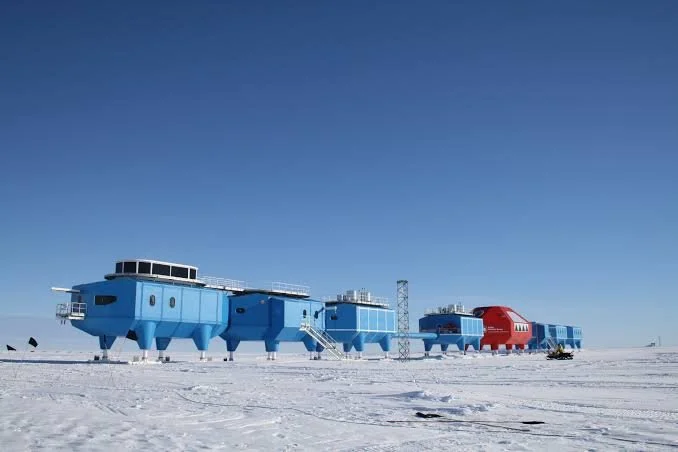
The station itself is almost as interesting as the science. Halley sits on the Brunt Ice Shelf, a slab of floating ice that drifts toward the sea at roughly 1,300 feet a year and periodically cracks. Rather than rebuild from scratch every time the ice shifted, the British Antarctic Survey designed Halley VI, completed in 2012, as eight interlinked modules mounted on hydraulic legs and giant skis — the world's first fully relocatable research station. When a major crack threatened the site in 2017, the entire station was towed 23 kilometers inland by bulldozer. Due to ongoing instability in the ice shelf, Halley currently operates without a winter crew, though summer research continues.
| Current structure completed | 2012 |
| Design | 8 relocatable modules on hydraulic skis |
| Landmark discovery | The Antarctic ozone hole, 1985 |
| Known for | World's first fully relocatable research station |
United Kingdom · Adelaide Island
6. Rothera Research Station
The largest British station
Perched on Adelaide Island along the western side of the Antarctic Peninsula, Rothera is the largest research station the British Antarctic Survey operates and functions as the UK's main gateway to the continent, much as McMurdo does for the United States. Its gravel airstrip and harbor make it a key transfer point for people and cargo moving between the Falkland Islands, other British stations, and the deep field camps scattered across West Antarctica.
The science at Rothera leans heavily on biology and glaciology, helped by its location near open water and marine wildlife for much of the year, along with a long-running atmospheric and space-weather monitoring program. A major modernization effort completed in recent years replaced much of the station's aging 1970s-era infrastructure, extending its working life well into the coming decades.
| Established | 1975 |
| Summer population | ~100 |
| Winter population | ~22 |
| Known for | UK's main Antarctic gateway; biology and glaciology research |
Argentina · Hope Bay, Antarctic Peninsula
7. Esperanza Base
A town, not just a base
Most Antarctic stations are staffed by researchers and support crews who rotate out after a season or two. Esperanza is different. Located at Hope Bay on the tip of the Antarctic Peninsula, it's one of only two permanent civilian settlements anywhere on the continent, with around 55 residents through the winter, including roughly ten families and a small school with its own teachers.
The base has a striking piece of political history behind its family housing. In 1977, Argentina sent a pregnant woman to Esperanza specifically so she could give birth there, a deliberate move intended to strengthen the country's territorial claim to the region. Eight children have since been born at the base. Along with its role in Argentine Antarctic policy, Esperanza is also one of the most frequently visited stations by Peninsula cruise passengers, thanks to its accessible location and its post office — a favorite stop for travelers mailing postcards from the bottom of the world.
| Established | 1953 |
| Winter population | ~55, including 10 families |
| Buildings | 43, including a school and chapel |
| Known for | One of only two permanent civilian towns in Antarctica |
Chile · King George Island, South Shetlands
8. Villa Las Estrellas & Frei Base
Chile's answer to Esperanza
Attached to Chile's Frei Base on King George Island, Villa Las Estrellas is the other of Antarctica's two permanent civilian settlements — and Chile pursued the idea with even more intent than Argentina did at Esperanza. In the years after Argentina's first Antarctic birth, Chile began sending newly married couples south specifically to conceive and deliver the first baby born on Antarctic soil, a title claimed by Emilio Marcos Palma in 1978.
Today the settlement functions much like a very small, very cold company town: around 150 people in summer, dropping to closer to 80 in winter, with a school serving roughly 15 children, a post office, a bank branch, and a small hospital. Its location on King George Island, just off the tip of the Peninsula, also makes Frei Base's airstrip one of the busiest points of entry to Antarctica, used by multiple countries' fly-cruise programs to bypass the Drake Passage entirely.
| Summer population | ~150 |
| Winter population | ~80 |
| Notable first | Emilio Marcos Palma, first person born in Antarctica, 1978 |
| Known for | Civilian settlement; major fly-cruise gateway airstrip |
Ukraine · Galindez Island, Antarctic Peninsula
9. Vernadsky Research Station
The station with the bar
Vernadsky began life in 1954 as the British station Faraday, and its early data collection contributed to the same ozone research that made Halley famous. When Ukraine became independent after the Soviet collapse, it needed a foothold in Antarctic science to become a signatory to the Antarctic Treaty. Britain sold Faraday to Ukraine in 1996 for a symbolic £1, and it's operated as Vernadsky ever since.
Among Peninsula travelers, Vernadsky is best known for something almost nobody expects to find on the seventh continent: a fully stocked bar, built and run by the station's own scientists, complete with a pool table and a reputation as one of the more sociable stops on a Peninsula itinerary. It's a small, human detail that tends to surprise visitors more than almost anything else they see in Antarctica — proof that even in one of the most extreme environments on Earth, people still find a way to build a local.
| Established | 1954 (as British station Faraday) |
| Transferred to Ukraine | 1996, for £1 |
| Winter population | ~12 |
| Known for | Its bar — a favorite stop on Peninsula cruise itineraries |
New Zealand · Ross Island
10. Scott Base
McMurdo's next-door neighbor
Scott Base sits just under two miles from McMurdo Station, connected by a proper road across Ross Island — a genuine oddity in a place where no two research stations are otherwise linked by anything more than a radio channel. New Zealand's Antarctica New Zealand program has run the station since 1957, and its close relationship with the much larger American operation next door has become one of the more practical partnerships on the continent: New Zealand and US personnel routinely share flights, fuel, and emergency support.
Despite the proximity, Scott Base has its own distinct culture and focuses its research on marine biology, seismology, and long-term climate monitoring from the Ross Sea region. A major rebuild of the station, one of the largest construction projects ever undertaken in Antarctica, has been underway in recent years to replace facilities dating back to the station's original 1957 buildings.
| Established | 1957 |
| Distance to McMurdo | ~3km (1.9 miles) by road |
| Summer population | ~85 |
| Known for | Closest neighboring relationship between two nations' stations |
The Full Comparison
All ten stations, side by side.
| Station | Country | Location | Established | Winter Pop. | Known For |
|---|
| McMurdo Station | United States | Ross Island | 1955 | ~150 | Largest station; logistics hub |
| Amundsen-Scott South Pole | United States | Geographic South Pole | 1956 | ~45–50 | IceCube Neutrino Observatory |
| Vostok Station | Russia | East Antarctic Plateau | 1957 | ~13 | Coldest temp ever recorded; Lake Vostok |
| Concordia Station | France / Italy | Dome C | 2005 | ~13 | ESA astronaut isolation research |
| Halley VI | United Kingdom | Brunt Ice Shelf | 2012 (current structure) | Summer only | Discovery of the ozone hole |
| Rothera Research Station | United Kingdom | Adelaide Island | 1975 | ~22 | UK's main Antarctic gateway |
| Esperanza Base | Argentina | Hope Bay, Peninsula | 1953 | ~55 | Permanent civilian town |
| Villa Las Estrellas / Frei | Chile | King George Island | 1969 | ~80 | Civilian town; fly-cruise gateway |
| Vernadsky Research Station | Ukraine | Galindez Island, Peninsula | 1954 (as Faraday) | ~12 | Its bar; ozone research history |
| Scott Base | New Zealand | Ross Island | 1957 | ~11 | Road-linked to McMurdo |
Frequently Asked Questions
How many research stations are there in Antarctica?
Roughly 70 research stations are currently active across Antarctica, operated by 29 different countries under the Antarctic Treaty System. Around 40 of these run year-round, while the rest open only for the summer research season between October and March.
Can tourists visit Antarctic research stations?
Some stations do host visits from expedition cruise passengers, most commonly Esperanza Base, Vernadsky Research Station, and Port Lockroy. Visits are arranged in advance by the cruise operator and depend on the station's schedule, weather, and IAATO guidelines limiting group size and time ashore.
Do people live permanently in Antarctica?
No country recognizes permanent residency in Antarctica, and there are no indigenous inhabitants. However, Argentina's Esperanza Base and Chile's Villa Las Estrellas function as year-round civilian settlements with resident families, schools, and children who have lived there for years at a stretch.
What is the coldest research station in Antarctica?
Vostok Station holds the record for the coldest verified surface temperature ever measured on Earth, at -89.2°C (-128.6°F) in July 1983. Concordia Station, at nearby Dome C, has come close to that mark in more recent winters and is considered the coldest currently inhabited research station.
Which country has the most research stations in Antarctica?
Argentina, Chile, and Russia each operate among the largest numbers of stations and facilities on the continent, reflecting long-running territorial interests in the region. The United States, through the National Science Foundation, runs the largest single station by population and infrastructure at McMurdo.
How do people get to and from Antarctic research stations?
Most personnel and cargo arrive by ship during the summer season or by ski-equipped aircraft flying from staging points such as Christchurch, New Zealand, or Punta Arenas, Chile. Interior stations like Amundsen-Scott and Concordia are reachable only by aircraft or, for cargo, by long overland traverses.
A Note on the Numbers
Population figures above reflect typical seasonal staffing and can vary year to year depending on funding, construction projects, and scientific priorities. Winter populations are generally far smaller than summer populations because most research and construction activity is only possible during the short Antarctic summer.
Access to any research station as a visitor is never guaranteed and is arranged entirely at the discretion of the operating country and the expedition operator, in line with Antarctic Treaty and IAATO rules protecting the continent's science and its fragile environment.
Many Antarctic Peninsula itineraries pass within sight of — or land beside — several of the stations above. Tell us what you want to see, and we'll build a route around it.
Book a Call With Our Team