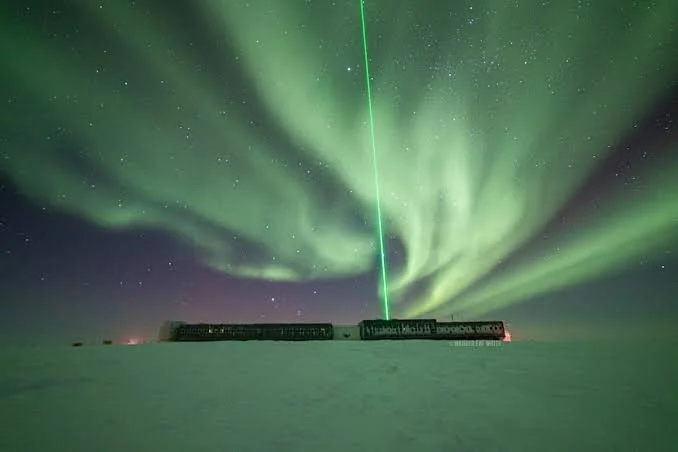
Southern Lights in Antarctica: When & Where to See Them
The aurora australis is real, it's spectacular, and most Antarctica cruises sail straight past it in broad daylight. Here's how to time your trip so you don't.
By Amer Khan | 11 min read
Can you see the southern lights on an Antarctica cruise? Yes. But not on most of them, and the reason has nothing to do with luck.
The aurora australis glows over Antarctica almost every night of the year. The problem is that tourist ships only sail in the southern summer, when the sun barely sets. A December voyage to the Antarctic Peninsula gives you penguin chicks and near-endless daylight, which is wonderful for wildlife and useless for aurora. If the southern lights are high on your list, the month you book matters more than the ship, the cabin, or the itinerary.
This guide covers what the lights actually are, why they're harder to catch than the northern lights, which voyages give you a real shot, and how to photograph them from a deck that won't stop moving.
The Science
1. What the Southern Lights Actually Are
Solar wind, magnetic field lines and very excited oxygen.
The sun constantly throws off a stream of charged particles called the solar wind. It usually travels at around 400 km per second, roughly 1.4 million km per hour, and faster streams can hit double that. Earth's magnetic field deflects most of it. Some particles get funneled along magnetic field lines toward the two magnetic poles, where they slam into oxygen and nitrogen in the upper atmosphere.
Those collisions excite the gas, and when it settles back down it releases light. That's the aurora. In the north it's called aurora borealis. In the south it's aurora australis. Same process, same sun, often happening at the same moment as a mirror image in both hemispheres.
Most aurora forms around 100 to 250 km up, well above where planes fly. The color depends on which gas gets hit and how high:
Color
Source
Typical altitude
Green
Oxygen (557.7 nm). The most common color and the one cameras pick up best
~100–250 km
Red
Oxygen (630 nm). Shows up on the upper edges of strong displays
Above ~250 km
Pink / magenta fringe
Nitrogen on the lower edge of active curtains
Below ~100 km
Blue / violet
Ionized nitrogen, often during intense storms
Varies
The strongest displays come from coronal mass ejections, huge clouds of solar material that can reach Earth in one to three days. That lag is why forecasters can often warn of a big night a day or two ahead.
The Geography
2. Why They're Harder to See Than the Northern Lights
The auroral oval sits over ice and ocean, not over towns.
Auroras don't spread evenly across the polar sky. They form in a ring called the auroral oval, centered on the geomagnetic pole rather than the geographic South Pole. In the south, that pole sits deep in East Antarctica, not far from Russia's Vostok Station, on the Australian side of the continent.
In the Northern Hemisphere the oval crosses Alaska, Canada, Iceland and northern Scandinavia, so millions of people live under it. In the south, it lies almost entirely over the Antarctic ice sheet and the Southern Ocean. Nobody lives there except research staff.
This has a practical consequence most guides skip. Because the magnetic pole is tilted toward Australia, the South American side of Antarctica sits at a lower magnetic latitude than its map position suggests. Ushuaia is the world's southernmost city, yet its magnetic latitude is only around 42°, lower than Hobart's. From Ushuaia you generally need an extreme storm to see anything.
The Antarctic Peninsula: Usually just outside the core of the oval. You'll often need moderate storm activity for a strong display, though fainter glows are common on dark nights.
East Antarctica and the Southern Ocean south of Australia and New Zealand: Much closer to the oval. Australia's Casey and Mawson stations record frequent winter displays.
Deep interior near the pole: Sometimes too far inside the oval. During big storms the oval shifts north and the lights can end up over the horizon.
Timing
3. The Daylight Problem: Timing Your Antarctica Cruise
You can't see a light show with the house lights on.
The Antarctic cruise season runs from roughly November to March. Near the Peninsula in December and January, the sun dips just below the horizon for a few hours at most, and the sky never gets properly dark. The aurora is still up there. You just can't see it against a bright sky.
Darkness returns fast in the second half of the season. By late March, a ship at the Peninsula can get several hours of true night.
Month
Night sky near the Peninsula
Aurora odds
November
Long twilight, very little true darkness
Low
December
Near-constant daylight
Very low
January
Bright twilight at night
Very low
February
Short dark window returns, mostly late in the month
Low to fair
March
Several hours of real darkness, longest near the equinox
Best of the season
March has a second advantage. Geomagnetic activity tends to rise around both equinoxes (March 20 in the Southern Hemisphere autumn), thanks to the way Earth's tilt lines up its magnetic field with the solar wind. Scientists call it the Russell-McPherron effect. For you, it means late-March voyages get darker nights and statistically livelier skies at the same time.
The trade-off is real but mild. March has fewer penguin chicks on the beaches, but it's the peak month for whales, the light is golden and low, and fares usually drop. Pack properly, since nights on deck get cold. Check our live Antarctica weather and temperature updates before you pack.
Want a Voyage Timed for the Southern Lights?
Tell us your dates and we'll flag the late-season departures with the longest dark nights and the best routes for aurora.
Antarctic Peninsula, late season. The most common Antarctica cruise, and the most realistic aurora option for most travelers. March departures from Ushuaia give you dark hours in the Drake Passage and among the islands. Voyages that push south of the Antarctic Circle at 66°33′S get closer to the oval and add a few more hours of darkness.
South Georgia and the Falklands. South Georgia sits around 54°S, so its summer nights are darker than the Peninsula's and real darkness comes back earlier. Its magnetic position is modest, so you're relying on stronger activity, but late-season Falklands, South Georgia and Antarctica voyages give you more dark hours over the whole trip. You also get the king penguin colonies, covered in our king penguin guide.
Ross Sea voyages from New Zealand or Australia. This is the route aurora hunters should look at hardest. Ships sail from New Zealand or Hobart through the Southern Ocean, often stopping at Macquarie Island, which sits close to the southern auroral oval. The catch: McMurdo Sound keeps its midnight sun until late February, so the darkest nights come on the Southern Ocean crossings rather than deep in the Ross Sea. These trips run about four weeks and cost far more.
Wintering at a research station. The only way to see the Antarctic aurora at its best, night after night during months of polar darkness. It means a job with a national program, not a vacation.
Route
Best months
What works in your favor
Peninsula (classic)
Mid–late March
Easiest to book, several dark hours, lower late-season fares
Peninsula + Antarctic Circle
Late Feb–March
Farther south, darker nights than a standard Peninsula trip
Falklands, South Georgia & Peninsula
Late Feb–March
More total nights at sea, darker skies at 54°S
Ross Sea via Macquarie Island
Feb–March
Crosses closer to the auroral oval than any other tourist route
Closer to Home
5. Seeing Them Without Going to Antarctica
Tasmania and southern New Zealand have better odds than Ushuaia.
If the aurora is the main goal and Antarctica is optional, the best land-based spots are in Australia and New Zealand, because they sit on the magnetic-pole side of the Southern Ocean. The season there runs March to September, with longer nights in the southern winter.
Stewart Island (Rakiura), New Zealand: Southernmost inhabited part of the country and an International Dark Sky Sanctuary. One of the lowest storm thresholds anywhere in the populated south.
Invercargill and the Catlins coast: Easy access, dark south-facing beaches like Slope Point and Curio Bay.
Tasmania: South Arm, Bruny Island and kunanyi/Mount Wellington above Hobart, all looking out over the Southern Ocean.
Lake Tekapo: A dark-sky reserve with superb stargazing, though you'll usually need a stronger storm for aurora this far north.
Expectations matter here. From these latitudes, the aurora often sits low on the southern horizon, and on moderate nights it may look like a faint grey glow to your eyes while your phone camera shows green. A big storm changes everything. During the May 2024 storm, people photographed the southern lights from Sydney and Brisbane.
There's also the odd one out: aurora flights. In 2017 an astronomer at New Zealand's Otago Museum chartered a 767 from Dunedin and flew it toward the Antarctic Circle overnight. All 134 seats sold out within days. Similar flights have run since, but not on a fixed schedule.
Solar Cycle
6. Is 2026–27 Still a Good Season?
Past the peak, not past the good years.
The sun runs on a roughly 11-year activity cycle. NASA and NOAA announced in October 2024 that Solar Cycle 25 had reached its maximum, and the sun is now in its declining phase. That sounds like bad timing. It usually isn't.
Some of the biggest storms of a cycle often arrive a year or two after the peak. The famous Halloween storms of 2003 came about two years into Solar Cycle 23's decline. Solar Cycle 25 has kept that pattern going, with notable storms in November 2025 and January 2026.
For the 2026–27 Antarctic season, that means activity is still generally above the long-term average. The quiet stretch of solar minimum isn't expected until around 2030–31. If the southern lights are a reason you're going, this season and next are better bets than waiting.
On Board
7. How to Actually Catch Them From a Ship
The aurora rarely waits for you to finish dinner.
Ask about an aurora call. Many expedition ships will announce a display over the PA or add you to a wake-up list. Ask the expedition leader on day one. The bridge crew are the first to notice.
Watch the moon. A full moon washes out fainter displays. When comparing late-season departures, a voyage near the new moon is worth a small premium.
Check the forecast when you have Wi-Fi. The Kp index measures overall activity (Kp 5 and up is a storm). The number that matters more in the moment is Bz: when it turns south (negative) and stays there, displays tend to build. NOAA's Space Weather Prediction Center and apps like SpaceWeatherLive show both.
Face south, then look up. On the Peninsula, displays often start as a pale arc low on the southern horizon.
Get away from ship lights. Head to the darkest outer deck, usually the bow or top deck. Give your eyes 15 to 20 minutes and use a red headlamp.
Dress like you're staying out. A good display can pulse on and off for an hour or more. Wear the same layers you'd use for a Zodiac landing, including waterproof pants over your base layers.
Photography
8. Photographing the Aurora From a Moving Ship
Forget the 30-second exposures you've seen from Iceland.
Most aurora advice assumes solid ground. A ship moves, even at anchor, and engine vibration travels up any tripod. Long exposures turn stars into squiggles. The fix is to shoot short and fast: a wide, bright lens and a high ISO let you keep exposures to a few seconds.
Setting
Starting point on deck
Mode
Manual, RAW files
Lens
Wide angle, f/1.4 to f/2.8 (14–24 mm on full frame)
ISO
3200–6400, higher for faint displays
Shutter
1–4 seconds; shorter if the ship is rolling
Focus
Manual, set on a bright star or distant light, then tape the ring
Support
Brace against the rail or use a beanbag; a tripod helps more on shore
Phones do surprisingly well. Night mode on a recent iPhone or Pixel will often pick up green that your eyes read as grey. Brace the phone against something solid and hold still for the full capture.
Cold drains batteries quickly. Keep spares in an inside pocket and swap them out. When you come back indoors, leave the camera in a sealed bag for an hour so condensation forms on the bag, not inside the lens.
Southern Lights Odds by Trip Type
A quick way to compare your options before you book.
Trip
Dark nights
Aurora odds
Also good for
Peninsula, Nov–Jan
Almost none
Very low
Penguin chicks, midnight sun
Peninsula, March
Several hours
Fair
Whales, lower fares
Antarctic Circle, late season
Several hours
Fair to good
Deeper ice, fewer ships
Falklands & South Georgia, late season
Most nights of any Atlantic route
Fair
King penguins, history
Ross Sea via Macquarie Island
On Southern Ocean crossings
Good
Scott and Shackleton huts, emperor penguins possible
Tasmania / Stewart Island, winter
Long nights
Depends on storms
Short, cheap trip
Southern Lights FAQ
Can you see the southern lights on an Antarctica cruise?
You can see the southern lights on an Antarctica cruise, but mainly on late-season voyages in March. Earlier in the season the sky doesn't get dark enough. Even in March, you need solar activity and clear skies to line up.
What is the best month to see the aurora australis in Antarctica?
March is the best month to see the aurora australis on a tourist voyage. The nights are longest at the end of the cruise season and geomagnetic activity tends to peak near the March equinox. Research staff who winter over see far more, from April to September.
Can you see the southern lights from Ushuaia?
It's rare. Ushuaia sits at a low magnetic latitude because the south magnetic pole is on the Australian side of Antarctica, so the southern lights from Ushuaia usually require an extreme storm. Tasmania and southern New Zealand have better odds.
Do the southern lights look as bright as photos?
Usually not. The southern lights often look pale grey or faintly green to the naked eye, while cameras pick up far more color. During strong storms, though, the colors and movement are obvious without any camera.
Are the southern lights the same as the northern lights?
Yes. The southern lights and northern lights come from the same process and often happen at the same time. The southern version is harder to see because its auroral oval lies over Antarctica and the Southern Ocean rather than inhabited land.
Talk to an Antarctica Specialist
We'll compare late-season departures, ship sizes and cabin prices so you can pick the voyage with the best shot at the southern lights.