Wandering Albatross: Facts, Diet & Where to See Them
The bird with the biggest wingspan on earth, a glider that can circle the Southern Ocean without flapping, and your most faithful companion across the Drake Passage.
By Amer Khan | 8 min read
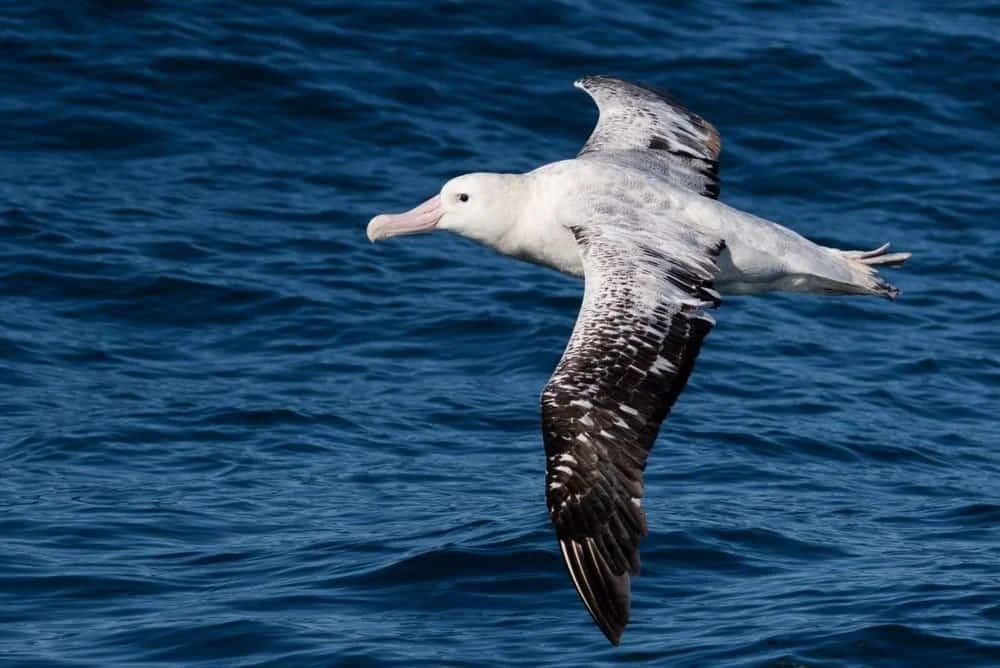
What's the biggest bird you'll see on an Antarctica trip? The wandering albatross, and by a wide margin. Its wings stretch more than 3 m from tip to tip, longer than any other living bird's. Watching one bank past the stern of your ship, barely moving a feather, is one of the quiet highlights of crossing the Drake Passage.
Wandering albatrosses don't nest on the Antarctic continent. They breed on sub-Antarctic islands such as South Georgia and spend most of their lives at sea, covering astonishing distances in search of squid and fish.
Here's what makes them remarkable, why they're in trouble, and how to give yourself the best chance of seeing one up close.
Species Profile
1. What Is a Wandering Albatross?
A seabird that lives on the wind
The wandering albatross is one of the "great albatrosses", a group of the largest seabirds on earth. It spends most of its life gliding over the open Southern Ocean and comes to land mainly to breed.
Its main breeding islands are scattered around the Southern Ocean: South Georgia, the Prince Edward Islands, the Crozet and Kerguelen Islands, and Macquarie Island. On an Antarctica voyage, South Georgia is the place you're most likely to visit.
Lifespan: commonly 50+ years; some birds live longer
First breeding: usually around 10 years old
Conservation status: Vulnerable, mostly due to fishing bycatch
Anatomy
2. Size, Wingspan & How to Recognize One
Long, narrow wings built for gliding
Feature
Detail
Wingspan
About 2.5–3.5 m (8–11.5 ft); averages around 3.1 m
Body length
About 1.1–1.35 m
Weight
Roughly 6–12 kg; males are larger
Bill
Large and pale pink, with a hooked tip
Breeding cycle
About a year per chick; pairs usually breed every two years
Wandering albatrosses get whiter with age. Young birds are mostly chocolate-brown, and over many years they turn white, starting with the face and body. The oldest males are almost entirely white apart from black wingtips.
At sea, the hardest part is telling a wandering albatross from its close relatives, like the royal albatross. Ask the ship's naturalists. Pointing out albatrosses is one of their favorite parts of the job.
Flight
3. How They Fly Without Flapping
Dynamic soaring on Southern Ocean winds
Wandering albatrosses barely flap. They use a technique called dynamic soaring, swooping down toward the waves and turning back up into the wind to gain height, again and again. The steady winds of the Southern Ocean power it all.
They also have a special tendon that locks their wings open, so holding them outstretched takes very little effort. The result is one of the most efficient ways of travel in the animal world.
Distance: foraging trips can cover thousands of kilometres
Around the world: tracked birds have circled the Southern Ocean in a matter of weeks
Why rough seas help: strong winds make flying easier, so a lumpy Drake crossing often brings the best views
Diet
4. What Wandering Albatrosses Eat
Squid, fish and whatever floats
Wandering albatrosses feed mostly at the surface, taking prey that is at or just below the waves. Much of their hunting may happen at night, when squid rise toward the surface.
Squid: the main part of the diet
Fish: an important second source
Carrion and scraps: they also scavenge, and have long followed fishing boats
That last habit is also their biggest danger, as the next sections explain.
Breeding
5. A Slow, Lifelong Partnership
One egg, a year of work, and a partner for life
Wandering albatrosses usually pair for life. Courtship involves an elaborate dance, with outstretched wings, bill clapping and sky-pointing calls. Once paired, a couple can stay together for decades.
One egg: laid in a large mud-and-grass nest, around December
Long incubation: roughly 11 weeks, shared by both parents
Long childhood: the chick stays on the nest through the winter and fledges about nine months after hatching
Every other year: because the cycle takes about a year, successful pairs generally breed every two years
This slow pace means populations take a very long time to recover from losses.
Conservation
6. Population & Threats
A long-lived bird with a slow recovery rate
The global population is estimated at around 20,000 mature birds, with several thousand pairs breeding each year. South Georgia holds a significant share, but numbers there have fallen sharply over recent decades.
The main threat is fishing. Albatrosses dive for baited hooks set by longline fishing boats, get caught and drown. Other threats include:
Invasive predators on some breeding islands, such as mice attacking chicks
Plastic pollution swallowed at sea and fed to chicks
Changing winds and ocean conditions caused by climate change
There is progress. Measures like weighted lines, bird-scaring streamers and night setting of hooks have cut bycatch sharply in many fisheries, and the successful rat eradication on South Georgia has helped its seabirds.
Where to Go
7. Where to See Wandering Albatrosses
At sea first, South Georgia second
Most travelers see wandering albatrosses from the ship's deck rather than on land:
The Drake Passage: albatrosses often follow ships for hours, especially on windy days
The Scotia Sea: on voyages between the Falklands, South Georgia and the Peninsula
Prion Island, South Georgia: a boardwalk to a breeding area, with landings managed and closed at some times of year to protect wildlife
Albatross Island, South Georgia: another breeding site, with restricted access
If albatrosses are high on your list, choose an itinerary that includes South Georgia. For the full seabird picture, pair it with our guide to king penguins, which share the same islands.
Field Tips
8. Watching Albatrosses Well
Stern, wind and patience
Head to the stern: albatrosses often glide in the ship's wake
Dress for the wind: the best viewing weather is also the coldest on deck
Hold on: keep one hand for the ship in rough seas
Use a fast shutter: 1/2000s or faster freezes a gliding bird. A 100–400mm lens is ideal. See our camera gear guide.
Keep your distance on land: stay on marked paths and at least 5 m from nests, and follow your guides
Wandering Albatross vs. Black-browed Albatross
The two albatrosses you're most likely to see from the ship
Feature
Wandering Albatross
Black-browed Albatross
Wingspan
About 2.5–3.5 m
About 2.1–2.5 m
Upper wings
White with age, black tips
Dark all over
Face
Plain white
Dark "eyebrow" stripe
Bill
Pale pink
Yellow-orange
Breeding frequency
Every two years
Every year
Where tourists see them
Drake Passage, Scotia Sea, South Georgia
Falklands, Drake Passage, South Georgia
Frequently Asked Questions
How big is a wandering albatross?
Its wingspan is usually about 2.5–3.5 m (8–11.5 ft), the largest of any living bird. It weighs roughly 6–12 kg.
Do wandering albatrosses live in Antarctica?
They feed in Antarctic and sub-Antarctic waters but breed on sub-Antarctic islands like South Georgia, not on the Antarctic continent.
How long do wandering albatrosses live?
Often 50 years or more. They usually start breeding at around 10 years old.
Why is the wandering albatross endangered?
It's listed as Vulnerable. The biggest threat is drowning on baited longline fishing hooks, along with invasive predators and plastic pollution.
Where is the best place to see a wandering albatross?
From the deck during the Drake Passage or Scotia Sea crossings, or at Prion Island on South Georgia, where landings are carefully managed.