The mammal that lives farther south than any other, dives deeper than 600 m, and keeps its breathing holes open with its teeth. It's also the seal most likely to be napping on your landing beach.
By Amer Khan | 8 min read
Which seal will you see most on the Antarctic Peninsula? Often a Weddell seal, stretched out on a beach or ice floe, eyes half closed, looking entirely unbothered by your arrival. They're the classic "sleepy seal" of Antarctic landings.
That relaxed look hides an extraordinary animal. Weddell seals breed farther south than any other mammal, spend the winter under solid sea ice, and dive to depths beyond 600 m. They keep their breathing holes open by grinding at the ice with their teeth.
Here's what to know about them, and how to spot one on your trip.
Species Profile
1. What Is a Weddell Seal?
The world's southernmost mammal
The Weddell seal is a "true seal", with no external ears and short front flippers. It lives around the entire Antarctic continent, mostly on the fast ice that stays attached to the coast. No other mammal breeds as far south.
It's named after James Weddell, a British sealing captain who sailed into the sea that also carries his name in the 1820s.
Lifespan: usually around 20 years or more
Conservation status: Least Concern
Relatives: one of Antarctica's four "ice seals", with the crabeater, leopard and Ross seals
Anatomy
2. Size, Coat & How to Recognize One
Spotted, plump and permanently smiling
Feature
Detail
Length
About 2.5–3.5 m (8–11.5 ft)
Weight
Roughly 400–600 kg
Maximum dive depth
About 600 m+ (2,000 ft)
Longest dive
More than an hour; around 80 minutes recorded
Pup at birth
About 1.5 m and 25–30 kg
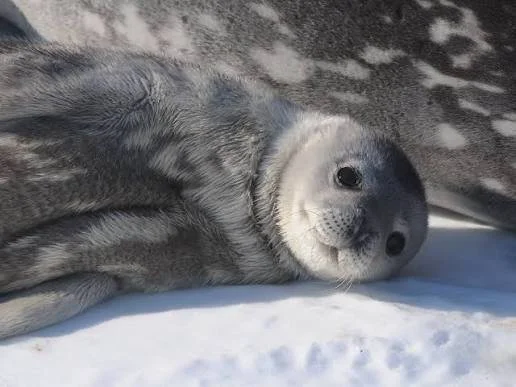
Weddell seals have a dark grey coat with silvery spots and streaks, which fades toward brown before the annual molt. Their heads look small for their big bodies, and the upturned mouth gives them a gentle, smiling expression.
Compared with a leopard seal, a Weddell is plumper, has a small, cat-like face, and lacks the leopard seal's long, reptilian head and huge jaw.
Diet
3. What Weddell Seals Eat
Fish from the deep
Weddell seals are fish specialists, which sets them apart from krill-eating neighbors like the crabeater seal.
Antarctic silverfish: a small, abundant fish and a staple of the diet
Antarctic toothfish: a large, deep-water fish taken on long dives
Squid and other invertebrates: including some krill, but only a minor part of the diet
They often hunt by silhouette, swimming below prey and spotting fish outlined against the light coming through the ice above.
Behavior
4. Record-Breaking Divers
Deep, long and carefully planned
Weddell seals are among the best divers of any seal. Most dives are shorter and shallower, but they're capable of going deeper than 600 m and staying under for more than an hour.
How do they do it? A few key adaptations:
Oxygen storage: lots of blood rich in hemoglobin, and muscles packed with myoglobin to store oxygen
Slowing down: their heart rate drops sharply on deep dives to save oxygen
Collapsing lungs: they breathe out before diving, reducing problems with pressure
Research suggests they time their most extreme dives carefully, often when prey is deepest and the payoff is greatest.
Winter Survival
5. Life Under the Ice
Breathing holes kept open by teeth
Unlike most seals, Weddells don't head north in winter. They stay in the far south under the fast ice, where the water is actually warmer than the air above.
To breathe, they use cracks and holes in the ice. When a hole starts freezing over, they keep it open by rasping at the edges with their teeth. It works, but it has a cost: their teeth wear down over the years, which may shorten their lives.
Weddell seals are also very vocal. Under the ice, they produce trills, chirps and whistles that can sound strangely electronic. On some Zodiac cruises, guides lower a hydrophone so you can listen in.
Breeding
6. Pups & Population
Born on the ice, swimming within weeks
Weddell seal pups are born on the fast ice from about September to November, before most tourist voyages begin. Mothers nurse for around five to seven weeks, and pups start swimming within a couple of weeks of birth.
Rich milk: pups can more than double their weight during nursing
Population: estimates vary widely, from several hundred thousand to around a million
Weddell seals are generally considered stable, and they were never heavily hunted on the scale of fur seals. The main long-term concerns are changes in sea ice and in the fish they depend on.
Where to Go
7. Where to See Weddell Seals
Beaches, floes and fast ice around the Peninsula
The Antarctic Peninsula: often hauled out on beaches and ice at landings such as Neko Harbour and Paradise Harbour
The South Shetland Islands: regularly seen on shore
The Weddell Sea: on sea ice and floes, especially on eastern Peninsula itineraries
The Ross Sea: large breeding groups on fast ice near McMurdo Sound, on specialist voyages
For all six of Antarctica's seal species and how to tell them apart, read our guide to seals in Antarctica.
Field Tips
8. Watching Seals Well
Sleepy does not mean tame
IAATO guidelines ask visitors to stay at least 5 m (15 ft) from seals, and farther if an animal reacts. Weddells are usually calm, but they're large, wild animals.
Watch their reaction: if a seal lifts its head, rolls to face you or moves away, step back
Never stand between a seal and the water: it's their escape route
Crouch low for photos: eye-level shots of a resting Weddell are some of the best seal portraits. See our camera gear guide.
Listen: if your guide has a hydrophone, ask to hear the seals under the water
Weddell Seal vs. Leopard Seal vs. Crabeater Seal
The three seals you're most likely to see on the Peninsula
Feature
Weddell Seal
Leopard Seal
Crabeater Seal
Length
About 2.5–3.5 m
Up to about 3.8 m
About 2.2–2.6 m
Head
Small, round, "smiling"
Long, reptilian, huge jaw
Slender, pointed snout
Coat
Dark grey with silver spots
Grey with dark spots on a pale throat
Pale, often cream in summer
Main diet
Fish and squid
Krill, penguins, fish, young seals
Almost entirely krill
Where tourists see them
Beaches and ice at landings
Ice floes near penguin colonies
Floes in the pack ice
Frequently Asked Questions
How big is a Weddell seal?
Adults are about 2.5–3.5 m (8–11.5 ft) long and weigh roughly 400–600 kg. Females are slightly larger than males.
How deep can a Weddell seal dive?
Deeper than 600 m (2,000 ft), and for more than an hour. Most dives are shorter and shallower.
What do Weddell seals eat?
Mainly fish such as Antarctic silverfish and toothfish, plus squid. Krill is only a small part of their diet.
Are Weddell seals dangerous?
They're usually calm and often sleep through visits. They're still large wild animals, so keep at least 5 m away and follow your guides.
Why are Weddell seals called the southernmost mammal?
They breed on fast ice around the Antarctic coast, including the Ross Sea, farther south than any other mammal.